SFRS(I) 9 vs IFRS 9: Differences and Adoption in Singapore
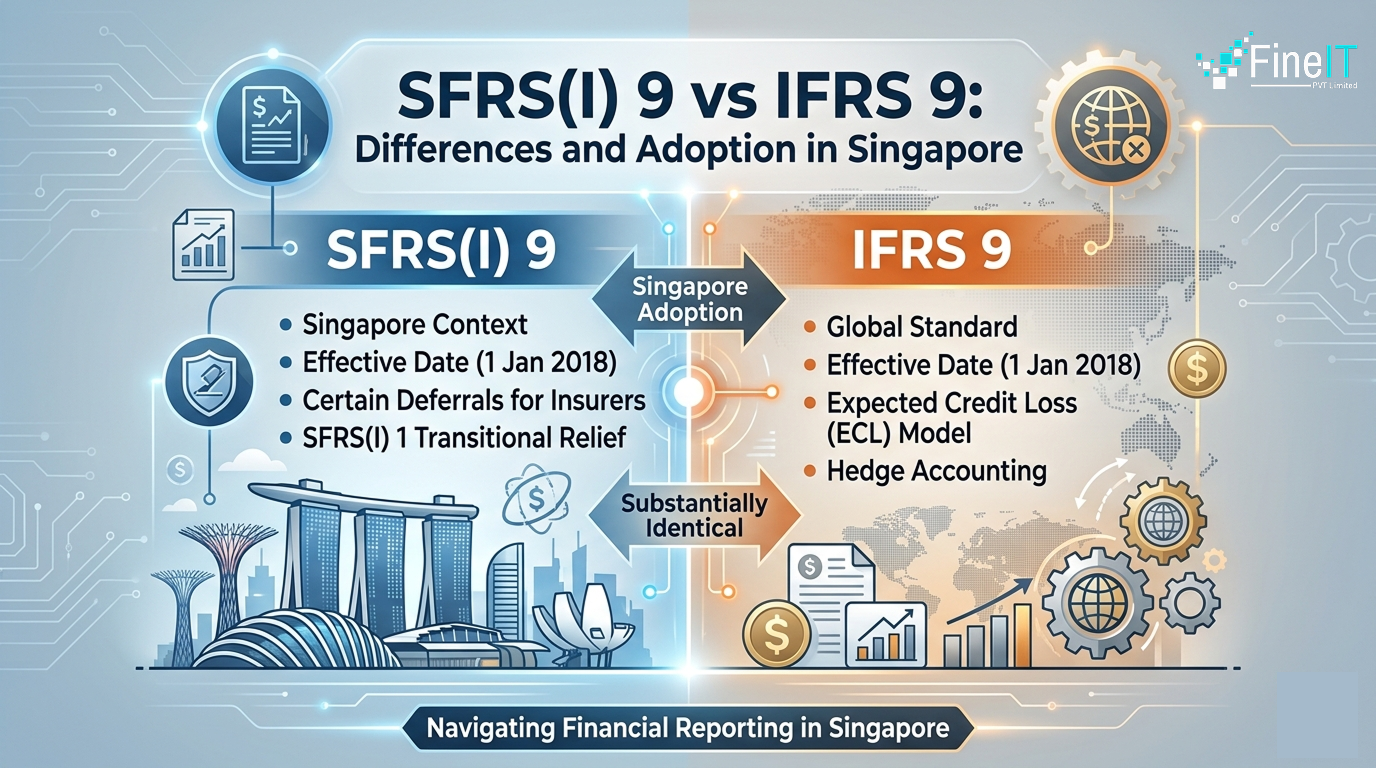
In the world of Singaporean finance, the shift to SFRS(I) 9 represented a landmark transition toward global transparency. While the names “SFRS(I) 9” and “IFRS 9” are often used interchangeably, understanding the specific context of Singapore’s adoption is crucial for businesses operating in the Lion City.
As of 2026, Singapore remains fully committed to this framework, with recent updates further aligning it with global sustainability and debt reporting requirements.
What are the core concepts of SFRS(I) 9 vs. IFRS 9?
Both standards govern Financial Instruments, replacing the older, more complex IAS 39/FRS 39 models. They focus on three main pillars:
How do classification and measurement work under SFRS(I) 9?
IFRS 9:
Uses a “Business Model” test and a “Contractual Cash Flow” (SPPI) test to decide if an asset is measured at Amortised Cost, Fair Value through Other Comprehensive Income (FVOCI), or Fair Value through Profit or Loss (FVTPL).
SFRS(I) 9:
Adopts these identical criteria. It ensures that a Singaporean bank’s balance sheet is readable and comparable to a bank’s in London or New York.
2. The Impairment Model (Expected Credit Loss)
The most significant change was the move from an incurred loss model to the Expected Credit Loss (ECL) model.
The Logic:
You no longer wait for a “trigger event” (like a missed payment) to recognize a loss. Instead, you must account for potential future losses from day one.
The Difference:
There is no technical difference between the two standards here. Both require a three-stage approach based on the change in credit risk since initial recognition.
How does hedge accounting function under SFRS(I) 9?
Both standards aim to align accounting more closely with a company’s actual risk management strategy. This makes it easier for entities to reflect their hedging activities—like currency or interest rate swaps—in their financial statements without the “artificial” volatility seen under older standards.
Key Differences: Is there a “Singapore Twist”?
Technically, SFRS(I) 9 is identical to IFRS 9. The “International” in parentheses—SFRS(I)—was specifically added to signal that any company complying with this standard can also claim full compliance with IFRS.
However, there are contextual differences in how they are managed:
| Feature | IFRS 9 (International) | SFRS(I) 9 (Singapore) |
| Issuer | IASB (International) | ASC (Singapore) |
| Effective Date | 1 January 2018 | 1 January 2018 (Full Adoption) |
| SME Treatment | Use “IFRS for SMEs” | Can use “SFRS for Small Entities” (which is simpler) |
| Tax Integration | Varies by country | Closely integrated with IRAS (tax) guidelines |
| Transition | Standard IFRS 1 rules | Use of SFRS(I) 1 for first-time adopters |
The “Insurance” Exception
One of the few historical differences was the deferral for insurers. Singapore allowed certain insurers to delay the adoption of SFRS(I) 9 until 2023 to coincide with the rollout of the insurance-specific standard, SFRS(I) 17. By 2026, this gap has closed, and the two are now in full synchronization.
What is the adoption landscape for SFRS(I) 9 in Singapore?
How do requirements differ between listed companies and private entities?
Since 2018, all Singapore-incorporated companies listed on the SGX must use the SFRS(I) framework. Private companies have the option but often choose it if they have international stakeholders or plan to go public.
What are the tax implications for IRAS purposes?
In Singapore, the Inland Revenue Authority (IRAS) generally aligns tax treatment with SFRS(I) 9. For example, the “FRS 109 Tax Treatment” allows companies to align their tax reporting for financial instruments on a revenue account with their accounting treatment, reducing the need for complex tax adjustments.
What are the 2026 updates regarding sustainable debt?
As of 2026, new amendments to SFRS(I) 9 (mirroring IFRS 9) have been introduced to address Sustainable Debt. This includes clarifications on how to account for financial instruments with “ESG-linked” features, ensuring that green bonds and sustainability-linked loans are measured accurately without triggering unnecessary fair value volatility.
What are the key takeaways?
The “vs.” in SFRS(I) 9 vs. IFRS 9 is largely a matter of jurisdiction rather than content. For a Singaporean business, adopting SFRS(I) 9 is not just about compliance; it’s a “passport” to global capital markets.
At FineIT, we support financial institutions across Singapore with end-to-end IFRS 9 and SFRS(I) 9 implementation—from ECL modeling and risk analytics to automated regulatory reporting.
Discover how FineIT can streamline your IFRS 9 compliance.
🌐 https://fineit.io
Request a demo: https://fineit.io/request-demo
Frequently Asked Questions
About FineIT Private Limited
FineIT Private Limited is a leading Fintech provider.
Published by
Muzammal Rahim
FineIT Private Limited — IFRS and Basel compliance software, incorporated in Islamabad, Pakistan, in April 2022,