Navigating IFRS 9 in Nepal: From Compliance to Strategic Risk Management
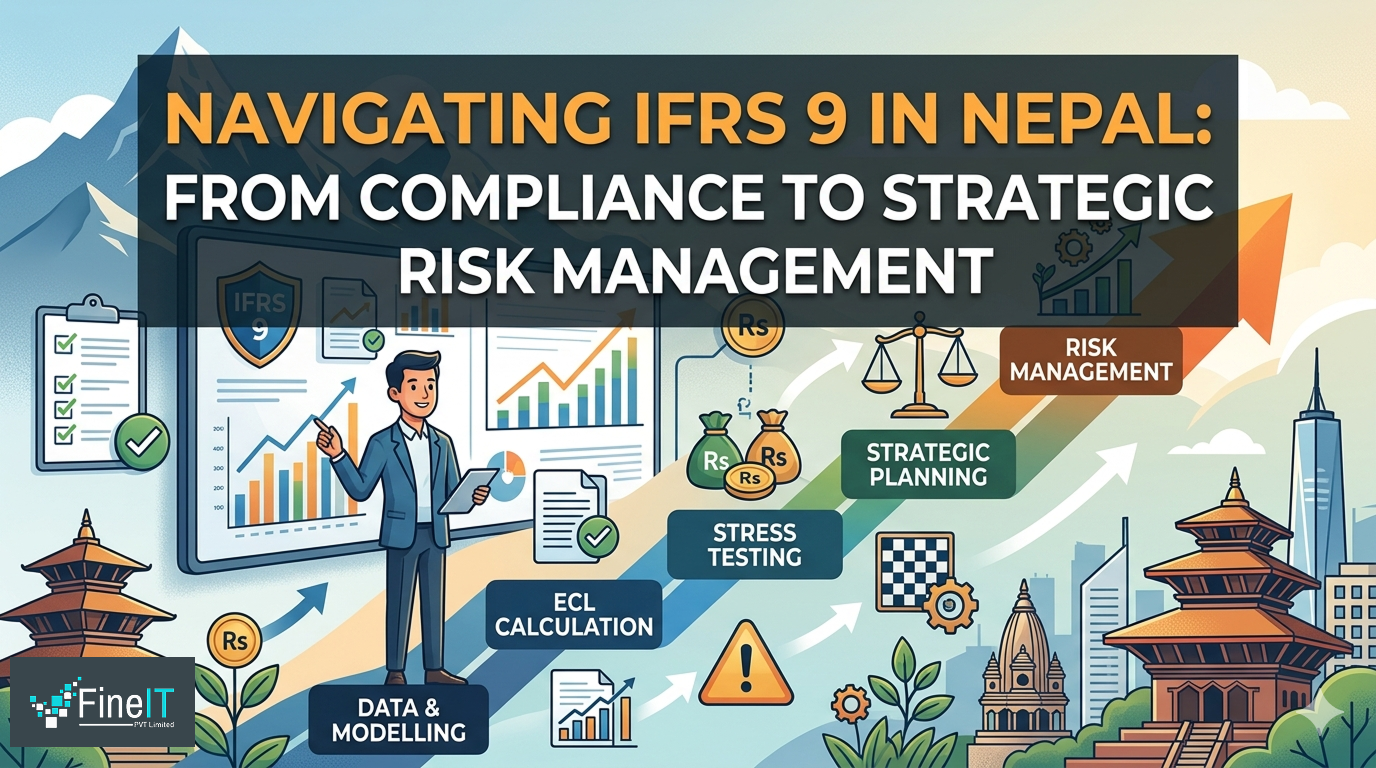
The transition to IFRS 9 (locally implemented as NFRS 9) represents one of the most significant shifts in the history of Nepal’s financial sector. For years, the banking industry relied on an “incurred loss” model—essentially waiting for a loan to fail before recognizing the loss.
As we move toward full implementation in FY 2081/82 (2024/25), the conversation is shifting. It is no longer just about checking a box for the Nepal Rastra Bank (NRB); it is about transforming compliance into a high-level tool for Strategic Risk Management.
1. The Paradigm Shift: From “Incurred” to “Expected”
The core of IFRS 9 is the Expected Credit Loss (ECL) model. Unlike the previous regime where provisions were made only after a “trigger event” (like a missed payment), IFRS 9 requires banks to recognize potential losses from the moment a loan is born.
What Is the Three-Stage Model for Expected Credit Loss Assessment?
To manage this, assets are categorized into three stages based on their credit health:
| Stage | Credit Risk Status | Impairment Measure |
| Stage 1 | No significant increase in risk | 12-month ECL: Losses expected within the next year. |
| Stage 2 | Significant Increase in Credit Risk (SICR) | Lifetime ECL: Losses expected over the entire life of the asset. |
| Stage 3 | Credit-impaired / Default | Lifetime ECL: Full losses recognized; interest calculated on net amount. |
2. Navigating the “Nepal Context” Challenges
While the global framework is clear, implementing it in Nepal comes with localized hurdles that require unique solutions:
Data Scarcity & Quality:
Calculating the Probability of Default (PD) and Loss Given Default (LGD) requires years of granular historical data. Many Nepalese BFIs (Banks and Financial Institutions) are currently racing to digitize old records and fix data gaps.
What Impact Does Macroeconomic Volatility Have on IFRS 9 Compliance?
IFRS 9 requires “forward-looking information.” In Nepal, where the economy is highly sensitive to remittances and tourism, building stable models that account for these fluctuations is a complex task.
The “Double Provisioning” Trap:
The NRB often maintains “Prudential Norms” (the old percentage-based rules) alongside NFRS. Banks may find themselves needing to maintain the higher of the two, which can squeeze capital adequacy.
3. How Can Organizations Move Beyond Compliance to Gain a Strategic Edge?
The most forward-thinking banks in Nepal are not just looking at the math; they are looking at the strategy. Here is how IFRS 9 becomes a management tool:
How Does IFRS 9 Enable Improved Capital Allocation?
By using IFRS 9’s detailed segment reporting, management can see exactly which sectors (e.g., Hydropower vs. SME) are generating the most risk-adjusted value. This allows for smarter lending decisions and better use of capital.
How Does IFRS 9 Support Proactive Risk Mitigation?
Because IFRS 9 forces a “forward-looking” view, banks can identify “Stage 2” warning signs early. Instead of waiting for a default, risk teams can restructure loans or engage with borrowers long before the crisis hits.
How Can IFRS 9 Compliance Help Attract Foreign Investment?
Standardizing financial reporting to IFRS levels makes Nepalese banks “speak the same language” as global investors. This transparency reduces perceived risk and can lead to lower costs of capital when seeking international funding or partnerships.
4. What Does the Roadmap to 2081/82 and Beyond Entail?
As the deadline for full implementation approaches, the focus for Nepalese BFIs should be on:
What IT Infrastructure Is Required for IFRS 9 Implementation?
Upgrading Core Banking Systems (CBS) to automate ECL calculations.
What Model Governance Framework Is Necessary for IFRS 9?
Establishing internal “Model Validation” teams to ensure the math stays accurate as the economy changes.
What Upskilling Initiatives Are Needed for Successful IFRS 9 Implementation?
Moving the internal culture from “Accounting” (historical) to “Risk Analytics” (predictive).
What Are the Key Takeaways for IFRS 9 Implementation in Nepal?
Navigating IFRS 9 in Nepal is a marathon, not a sprint. While the initial “day-one” impact may hit profitability and capital buffers, the long-term result is a more resilient, transparent, and internationally credible financial system. By embracing the standard, Nepal’s banks are not just following the rules—they are building the foundation for the next decade of growth.
As Nepal moves toward full IFRS 9 adoption, is your institution truly prepared?
FineIT delivers end-to-end IFRS 9 solutions—from data engineering to model validation—helping you stay compliant, resilient, and future-ready.
Learn more: https://fineit.io/
Frequently Asked Questions
About FineIT Private Limited
FineIT Private Limited is a leading Fintech provider.
Published by
Muzammal Rahim
FineIT Private Limited — IFRS and Basel compliance software, incorporated in Islamabad, Pakistan, in April 2022,