IFRS 9 Data Requirements and Modeling Techniques for Singapore Banks
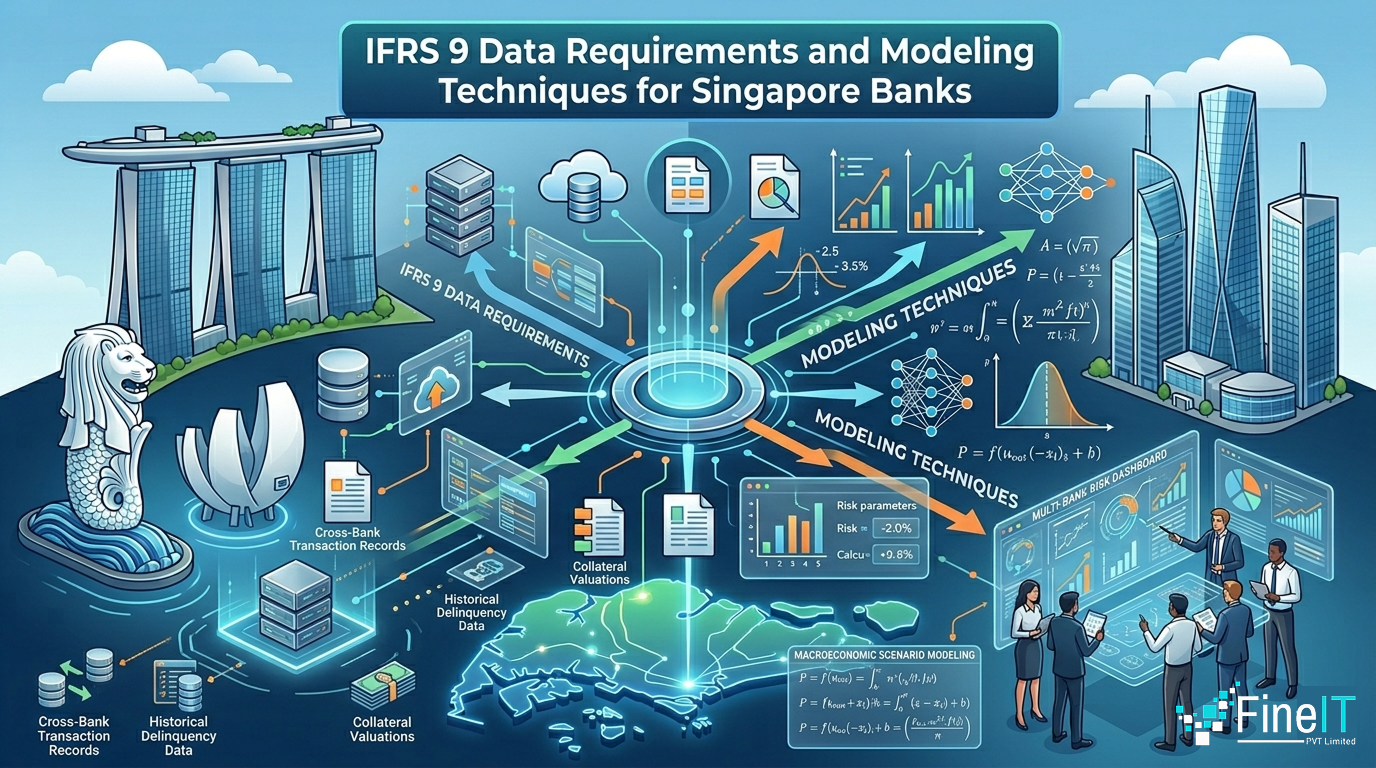
The implementation of IFRS 9 (Financial Instruments)—locally adopted as SFRS(I) 9—has fundamentally transformed how Singaporean financial institutions manage risk and report financial health. Moving away from the old “incurred loss” model, IFRS 9 mandates a forward-looking Expected Credit Loss (ECL) approach.
For banks in a global hub like Singapore, this shift requires a sophisticated blend of high-granularity data and advanced statistical modeling to satisfy both international investors and the Monetary Authority of Singapore (MAS).
1. What data requirements form the foundation of compliance?
IFRS 9 is notoriously “data-hungry.” To satisfy both accounting standards and MAS regulatory reporting (such as MAS 610/1003), banks must manage several critical data streams:
Why is Why is granular historical data essential? essential?:
Banks need years of loan-level data, including original credit ratings, repayment patterns, and collateral valuations. This historical “spine” is essential to calibrate the How is How is probability of default calculated? calculated?.
How do How do macroeconomic indicators impact ECL modeling? impact ECL modeling?:
Unlike previous standards, IFRS 9 requires forward-looking data. Singapore banks must integrate local and global forecasts, including GDP growth, Unemployment rates, and the Singapore Property Price Index (PPI).
What role does What role does SPPI testing data play? play?:
To measureSPPI Testing Data: assets at amortized cost, they must pass the Solely Payments of Principal and Interest (SPPI) test. This requires detailed data on contract features, especially for complex structured products common in the Singapore market.
How should How should ESG and climate risk data be integrated? be incorporated?:
Increasingly, MAS expects banks to incorporate environmental risks. This includes data on carbon taxes or physical climate risks that might impact a borrower’s ability to pay, particularly for real estate and maritime portfolios.
2. What modeling techniques comprise the ECL framework?
The core of IFRS 9 is the Three-Stage Impairment Model. Banks must categorize every financial asset into one of three stages based on its credit evolution since inception.
What are the What are the key modeling components??:
Probability of Default (PD):
The likelihood that a borrower will default. Banks often use Logistic Regression or Survival Analysis for this.
Loss Given Default (LGD):
The share of an asset that is lost if a default occurs. Modeling this involves estimating the “recovery rate” and the current hair-cut value of collateral.
Exposure at Default (EAD):
The total value a bank is exposed to at the time of default, accounting for utilized lines of credit and future drawdowns.
What What advanced techniques should be considered? should be considered?:
Point-in-Time (PIT) vs. Through-the-Cycle (TTC):
While Basel capital requirements often use TTC, IFRS 9 requires PIT estimates that reflect current and forecasted economic conditions.
Scenario-Based Modeling:
Banks must run multiple probability-weighted scenarios (e.g., Base, Optimistic, and Stress) to arrive at a final ECL figure.
Post-Model Adjustments (PMAs):
When quantitative models can’t capture “black swan” events (like sudden geopolitical shifts), banks use expert judgment to overlay qualitative adjustments.
3. What challenges are specific to Singapore?
While global standards apply, Singapore’s unique position introduces specific hurdles:
How does How does volatility in earnings affect modeling? affect modeling?:
The shift to “Lifetime ECL” for Stage 2 assets creates a “cliff effect.” If a large portfolio moves from Stage 1 to Stage 2 due to a minor economic downturn, provisions can skyrocket, leading to significant P&L volatility.
What What system integration challenges exist? challenges exist?:
Many Singapore banks operate on legacy systems not designed to share data between the Risk and Finance departments. Achieving “data lineage”—proving exactly where a number came from—is a major audit focus.
How can banks ensure How can models achieve regulatory alignment??:
Banks must balance IFRS 9 reporting with MAS Notice 637 (Capital Adequacy). Often, the data used for accounting must be reconciled with data used for regulatory capital, which is a complex technical process.
What are the three stages of ECL?
| Feature | Stage 1 (Performing) | Stage 2 (Underperforming) | Stage 3 (Non-Performing) |
| Criteria | No significant increase in credit risk | Significant Increase in Credit Risk (SICR) | Credit-impaired / Default |
| Loss Recognition | 12-month ECL | Lifetime ECL | Lifetime ECL |
| Interest Revenue | On gross carrying amount | On gross carrying amount | On net carrying amount |
What are the key takeaways?
The transition to IFRS 9 has moved credit risk from a retrospective accounting exercise to a core strategic function for Singaporean banks. Success in this environment is no longer just about having enough capital; it is about the quality of data and the agility of modeling.
As the Singaporean market continues to integrate ESG factors and digital banking evolves, the banks that can most accurately predict “Lifetime ECL” will be the ones that maintain the most stable balance sheets and investor confidence. The marriage of robust data architecture with sophisticated macroeconomic modeling is now the definitive “gold standard” for financial resilience in the region.
Strengthen your IFRS 9 strategy with expert support from FineIT—from ECL modeling to full compliance with Monetary Authority of Singapore.
👉 Explore: https://fineit.io | Book a demo: https://fineit.io/request-demo
Frequently Asked Questions
About FineIT Private Limited
FineIT Private Limited is a leading Fintech provider.
Published by
Muzammal Rahim
FineIT Private Limited — IFRS and Basel compliance software, incorporated in Islamabad, Pakistan, in April 2022,