Future Trends in IFRS 9 and Financial Risk Reporting in Singapore
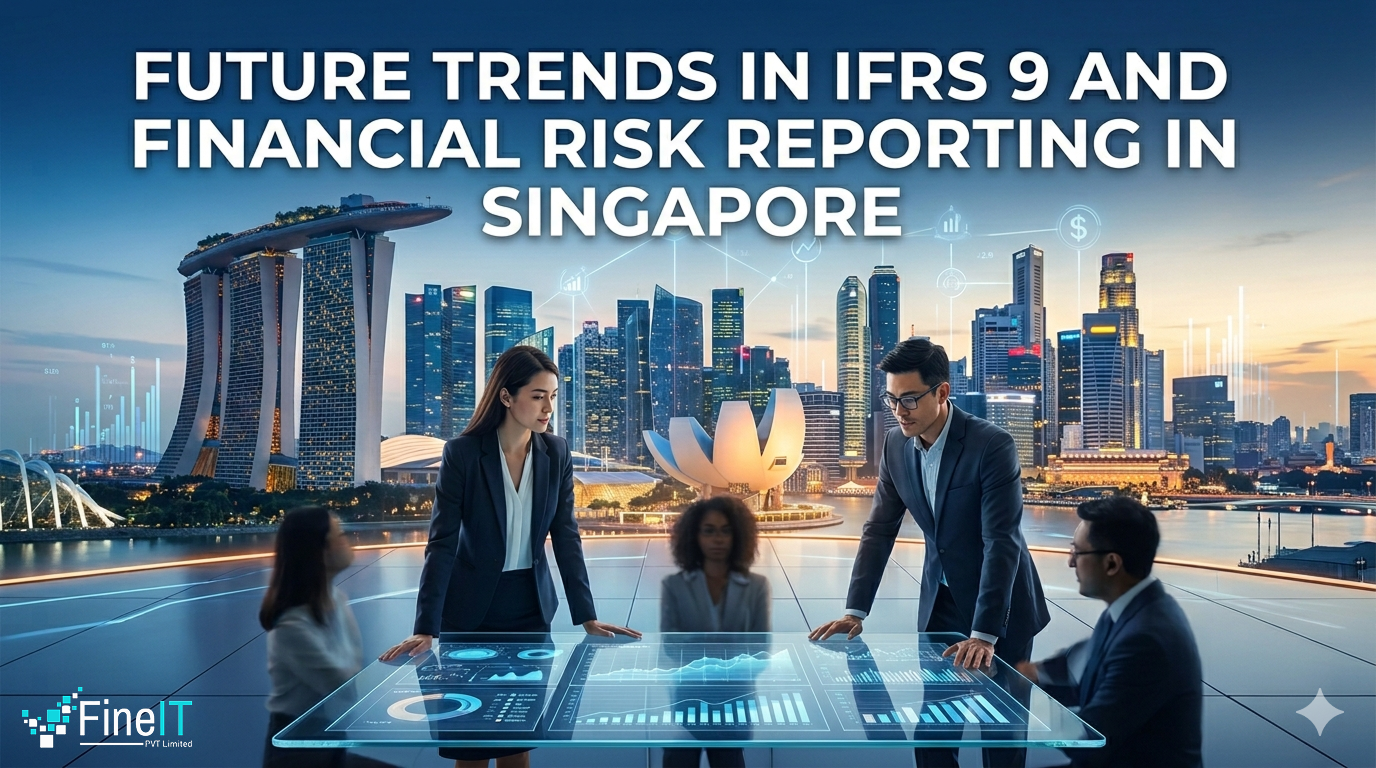
As we move through 2026, Singapore has firmly established itself as a global leader in the convergence of financial transparency and sustainability. The “compliance-only” mindset of the early 2020s has been replaced by a strategic integration of Artificial Intelligence (AI), Environmental, Social, and Governance (ESG) metrics, and real-time regulatory oversight.
1. Are We Entering an Era of Climate-Adjusted ECL Models?
The most significant trend in 2026 is the maturity of Climate-Integrated Expected Credit Loss (ECL) models. Following the Monetary Authority of Singapore (MAS) 2026 Guidelines on Environmental Risk Management, financial institutions are no longer just “considering” climate change; they are quantifying it.
How Can Organizations Implement How Should Organizations Approach Physical Risk Mapping??:
Banks now use geospatial data to adjust the collateral value of Singaporean real estate based on projected sea-level rises and flood risks, directly What Is the Impact on Financial Institutions?ing LGD (Loss Given Default) calculations.
What Are the Key What Transition Risk Scenarios Should Financial Institutions Consider??:
ECL models now incorporate carbon tax trajectories. Borrowers in high-emissions sectors face higher “Probability of Default” (PD) ratings unless they demonstrate a verified transition plan aligned with Singapore’s Net Zero 2050 goals.
2. Adoption of the 2026 “Settlement-Date” Amendments
Effective January 1, 2026, the IASB’s narrow-scope amendments have changed the “moment of truth” for financial derecognition.
What Is Driving What Shift Is Occurring in Risk Assessment Practices? in Risk Reporting?:
Singaporean firms have moved away from derecognizing liabilities at the “instruction date.” Under the new rules, a liability remains on the balance sheet until the cash actually clears the banking system.
Impact:
This has ended the practice of “window dressing” liquidity ratios during the 2-3 day float period of large electronic transfers, providing investors with a more honest view of a company’s immediate cash position.
3. AI-Driven “Live” Risk Reporting
In 2026, the quarterly reporting cycle is becoming obsolete. Leading Singaporean fintechs and banks have transitioned to Continuous Risk Monitoring.
Why Are Why Are Early Warning Systems Critical for Risk Management? Critical?:
Instead of waiting for a payment to be missed, AI algorithms analyze alternative data—such as utility payment patterns or supply chain delays—to trigger a Stage 2 (SICR) classification before a default even occurs.
What Does How Is the AI Auditor Reshaping Financial Compliance? Mean for Compliance?:
As models become more complex, ACRA (Accounting and Corporate Regulatory Authority) now emphasizes “Model Explainability.” Firms must be able to explain why an AI moved a loan to Stage 3, ensuring the “black box” of machine learning remains transparent to regulators.
4. How Does IFRS 9 Connect with IFRS S1 and S2?
Singapore’s roadmap for mandatory climate reporting is now in full swing. For the first time, there is a “Golden Thread” linking sustainability reports to the financial statements.
How Should Organizations Approach Why Is Scope 3 Integration Essential for Comprehensive Risk Reporting??:
For STI (Straits Times Index) constituents, Scope 3 emissions data is now a mandatory input for credit risk assessments under IFRS 9, ensuring that a company’s entire value chain risk is reflected in its financial provisions.
What Are the Key Differences Between 2020 and 2026 Reporting Standards?
| Feature | 2020 Standard | 2026 Future Trend |
| ECL Data Sources | Internal history & GDP | Real-time AI & ESG Benchmarks |
| Derecognition | Initiation of payment | Actual Settlement (Post-2026 Rule) |
| Sustainability | Qualitative “Green” notes | Quantitative impact on Impairment |
| Reporting Frequency | Quarterly/Annual | Near Real-Time Dashboards |
What Are the Key Takeaways?
The future of financial risk reporting in Singapore is defined by precision and purpose. In 2026, IFRS 9 is no longer a static accounting exercise; it is a dynamic risk-management tool. By blending high-velocity AI data with long-term climate projections, Singaporean institutions are not just reporting on the past—they are actively proofing their balance sheets against the uncertainties of a rapidly changing world.
For the modern finance professional in Singapore, success now requires a dual fluency in both the rigorous mechanics of IFRS 9 and the evolving landscape of global sustainability standards.
Navigating the evolving landscape of IFRS 9 in Singapore requires more than compliance—it demands precision, automation, and forward-looking intelligence.
At FineIT, we help financial institutions transform their IFRS 9 frameworks with:
- Advanced ECL modeling & validation
- AI-driven risk analytics and reporting
- Seamless integration of ESG and regulatory requirements
👉 Ready to future-proof your IFRS 9 strategy?
Explore our solutions: https://fineit.io
Book a live demo: https://fineit.io/request-demo
Frequently Asked Questions
About FineIT Private Limited
FineIT Private Limited is a leading Fintech provider.
Published by
Muzammal Rahim
FineIT Private Limited — IFRS and Basel compliance software, incorporated in Islamabad, Pakistan, in April 2022,