Data and Reporting Requirements for IFRS 9 in Nepal
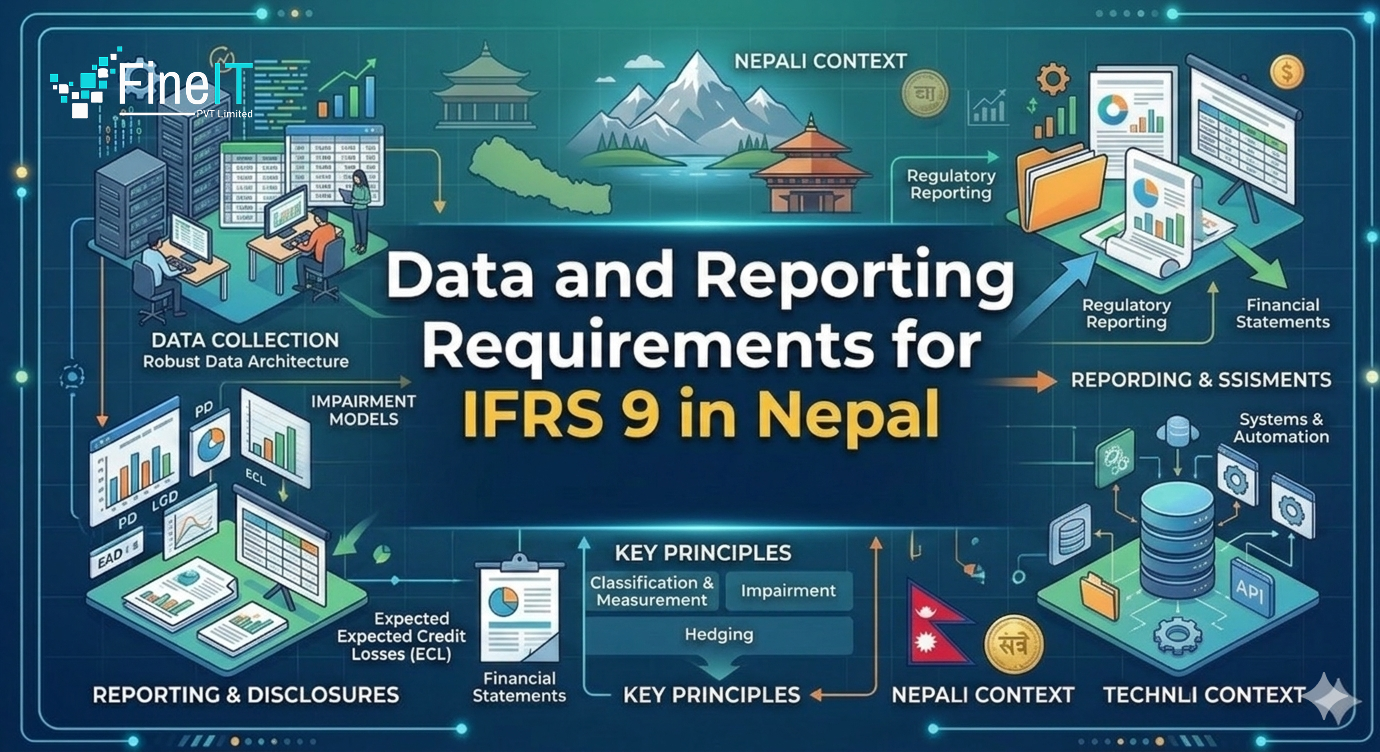
Implementing the International Financial Reporting Standard 9 (IFRS 9)—localized as NFRS 9 in Nepal—marks a paradigm shift for the country’s financial landscape. As mandated by the Nepal Rastra Bank (NRB), this standard moves banks from a reactive “incurred loss” model to a proactive “Expected Credit Loss” (ECL) framework.
The transition is data-intensive, requiring financial institutions to modernize their IT infrastructure and reporting protocols to meet stringent new transparency requirements.
1. What is the Core Pillar of Expected Credit Loss (ECL)?
Unlike the previous regime where provisions were made only after a loan defaulted, IFRS 9 requires banks to recognize potential losses from the moment a loan is originated. This is calculated using three primary components:
PD (Probability of Default):
The likelihood that a borrower will fail to pay.
LGD (Loss Given Default):
The percentage of the exposure the bank expects to lose if a default occurs.
EAD (Exposure at Default):
The total amount the bank is exposed to at the time of default.
2. What are the Data Requirements that Form the Foundation of Compliance?
To satisfy NRB’s “Expected Credit Loss Related Guidelines, 2024,” Nepalese banks must aggregate and process vast amounts of historical and forward-looking data:
Why is Historical Data Important?
Banks must maintain at least 5 to 10 years of historical data to build reliable models. This includes:
Repayment Histories:
Tracking delinquency trends and “cures” (when a late-paying borrower returns to normal status).
Recovery Data:
Specifics on collateral liquidation and the costs associated with recovery to calculate LGD.
How do Forward-Looking Information and Macro-Economic Factors Impact ECL?
IFRS 9 is unique because it requires banks to look into the future. In the context of Nepal, this involves integrating:
GDP Growth Projections:
General economic health.
Remittance Inflows:
A critical liquidity driver for the Nepalese economy.
Interest Rates & Inflation:
Factors that impact a borrower’s ability to serve debt.
What Segmentation Data is Required?
Loans must be grouped into “Stages” based on their credit risk profile:
Stage 1:
Low risk (12-month ECL).
Stage 2:
Significant Increase in Credit Risk (SICR) (Lifetime ECL).
Stage 3:
Defaulted/Credit-impaired (Lifetime ECL).
3. What are the Reporting and Disclosure Requirements?
The NRB mandates high-frequency and highly granular reporting to ensure market stability.
What are the Quarterly Returns Requirements?
Banks must submit detailed ECL reports to the Bank and Financial Institution Regulation Department of the NRB.
What are Movement Schedules?
Reporting how much money moved between Stage 1, 2, and 3 during the period.
What Qualitative Disclosures are Required?
Financial statements must now include “management judgment” notes, explaining the assumptions made regarding future economic conditions.
4. What are the Key Implementation Challenges in Nepal?
Despite the clear roadmap, Nepalese institutions face several hurdles:
Data Quality & Gaps:
Many older systems were not designed to store the granular transaction data required for LGD and PD modeling.
What Level of Technical Expertise is Needed?
A shortage of quantitative analysts capable of building and validating complex mathematical models.
What is Pro-cyclicality and How Does it Affect Implementation?
IFRS 9 can lead to higher volatility in profits, as provisions must increase during economic downturns precisely when banks are already under pressure.
5. What are the Strategic Next Steps?
For Class A, B, and C institutions in Nepal, the focus is now on FY 2081/82, the date for full implementation. Success depends on:
Why is Upgrading Core Banking Systems (CBS) Critical?
Ensuring they can automate ECL calculations.
Establishing “Model Governance”:
Policies for regular model back-testing and auditing.
What Training is Essential for IFRS 9 Implementation?
Upskilling finance and risk teams to interpret IFRS 9 outputs beyond just “compliance numbers.”
What are the Key Takeaways?
The transition to IFRS 9 (NFRS 9) in Nepal is more than a mere change in accounting policy; it is a fundamental transformation of risk management and financial reporting. While the requirements for high-quality data and forward-looking modeling present significant technical and operational hurdles, the long-term benefits are substantial. By aligning with global standards, Nepal’s financial sector will gain enhanced transparency, improved risk resilience, and greater international credibility. For Nepalese BFIs, the journey ahead requires a disciplined focus on data integrity and technological integration to ensure that compliance becomes a catalyst for more robust financial stability.
FineIT supports banks in Nepal with end-to-end IFRS 9 solutions—from ECL modeling to regulatory reporting.
Partner with FineIT for confident NFRS 9 compliance.
Frequently Asked Questions
About FineIT Private Limited
FineIT Private Limited is a leading Fintech provider.
Published by
Muzammal Rahim
FineIT Private Limited — IFRS and Basel compliance software, incorporated in Islamabad, Pakistan, in April 2022,