10 Benefits of IFRS 9: Simplifying Financial Instrument Accounting
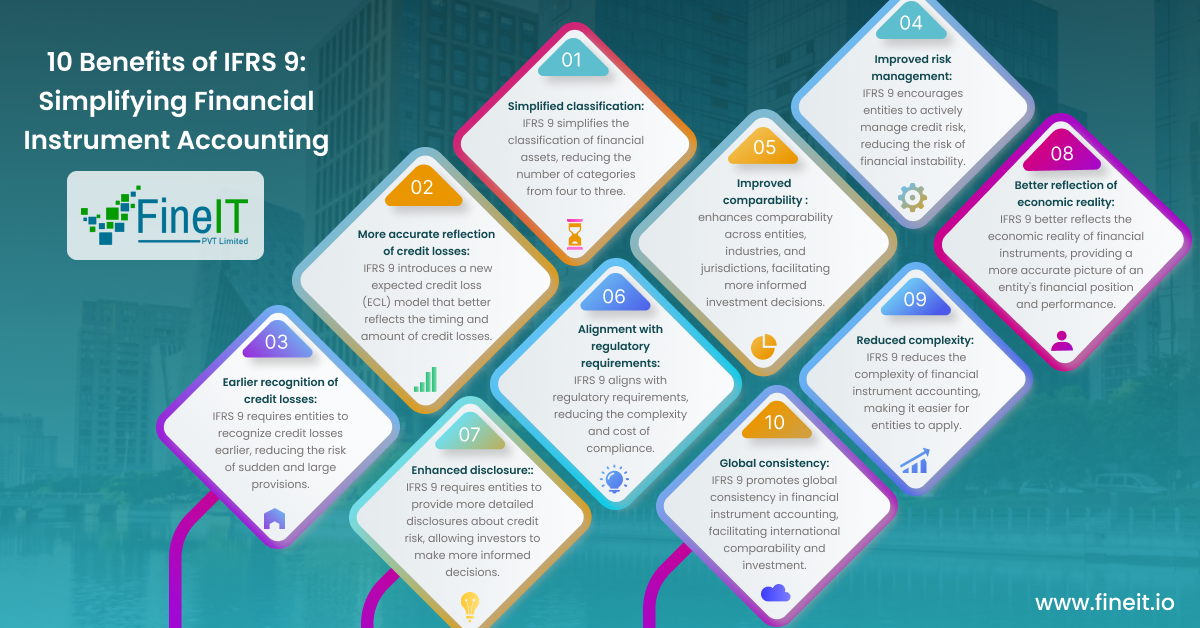
The International Financial Reporting Standard 9 (IFRS 9) has brought about significant changes in financial instrument accounting, offering numerous benefits to entities worldwide. Here are ten advantages of adopting IFRS 9:
1. How does IFRS 9 simplify the classification of financial instruments?
IFRS 9 streamlines the classification of financial assets, reducing categories from four to three, which simplifies accounting processes.
2. How does IFRS 9 enable more accurate measurement of credit losses?
With the introduction of the Expected Credit Loss (ECL) model, IFRS 9 provides a better reflection of the timing and amount of credit losses, enhancing accuracy in financial reporting.
3. Why does IFRS 9 require Why does IFRS 9 require earlier recognition of credit losses??:
Entities are now required to recognize credit losses earlier under IFRS 9, mitigating the risk of sudden and large provisions, and offering a more proactive approach to risk management.
4. How does IFRS 9 contribute to How does IFRS 9 support improved risk management practices??:
IFRS 9 encourages entities to actively manage credit risk, leading to better risk mitigation strategies and reduced financial instability.
5. What What enhanced disclosures does IFRS 9 require?s does IFRS 9 require?:
The standard mandates more detailed disclosures about credit risk, offering investors greater transparency and enabling them to make more informed investment decisions.
6. How does IFRS 9 align with regulatory requirements?:
IFRS 9 aligns with regulatory requirements, reducing complexity and costs associated with compliance efforts.
7. How does IFRS 9 improve the comparability of financial statements?:
By enhancing comparability across entities, industries, and jurisdictions, IFRS 9 facilitates better benchmarking and more informed investment decisions.
8. How does IFRS 9 reduce complexity in financial reporting?:
The standard simplifies financial instrument accounting, making it easier for entities to apply and reducing the burden of complex accounting rules.
9. How does IFRS 9 better reflect the economic reality of financial instruments?:
IFRS 9 offers a more accurate picture of an entity’s financial position and performance by better reflecting the economic reality of financial instruments.
10. How does IFRS 9 promote How does IFRS 9 promote global consistency in accounting standards? in accounting standards?:
Promoting global consistency in financial instrument accounting, IFRS 9 facilitates international comparability and investment, fostering a more integrated global financial system.
What is the overall What are the key takeaways from IFRS 9’s improvements? regarding IFRS 9’s impact?
In conclusion, the adoption of IFRS 9 brings about significant advantages for entities, including simplified processes, enhanced risk management, improved transparency, and global consistency, ultimately leading to better-informed decision-making and financial stability.
Frequently Asked Questions
About FineIT Private Limited
FineIT Private Limited is a leading Fintech provider.
Published by
Muzammal Rahim
FineIT Private Limited — IFRS and Basel compliance software, incorporated in Islamabad, Pakistan, in April 2022,